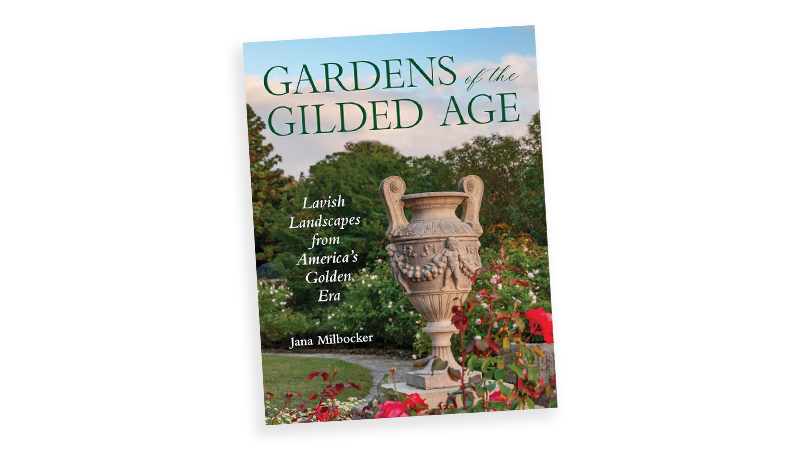
Let this book featuring gardens of the Gilded Age guide you in visiting opulent gardens in old sprawling estates up and down the East Coast – or you can enjoy the striking photos on the pages of the book. Once the domain of the wealthy, these gilded gardens are now open to the public. Jana Milbocker takes you there.
In the Gilded Age, a sprawling garden signaled great wealth and status, showcasing opulent, native blooms, finely pruned shrubbery, and sprinkles of exotic flora from obscure, faraway places. Wealthy Americans frequently traveled abroad, where they became fascinated with European architecture and formal garden layouts, which they incorporated into their own home and garden designs.
Today, we are fortunate to have access to many of these same estates, 30 of which are highlighted in a recently published book, Gardens of the Gilded Age: Lavish Landscapes from America’s Golden Era by Jana Milbocker.
In Gardens of the Gilded Age, Milbocker uses her own lush, contemporary photography combined with archival images to bring America’s iconic gardens to life for garden enthusiasts, travelers, and anyone interested in the history of the Gilded Age (1870-1920). The book makes an excellent travel guide for anyone what wants to experience what it was like to live on a grand estate in the early 20th century.
The book profiles homes from New England to Florida that are open to the public. Each profile features insider details on the eccentric owners, the evolution of the landscapes, and the striking architectural features that define them.
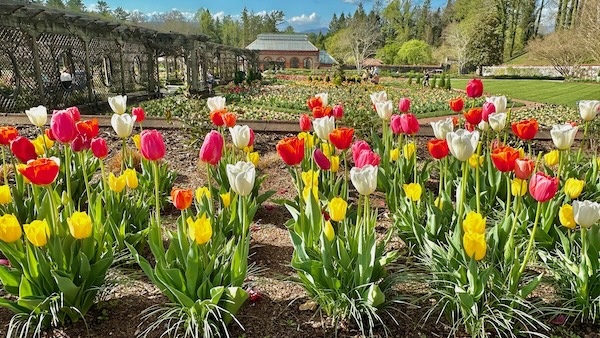
Six highlighted gardens of the Gilded Age
Here are some of our favorite homes and gardens from the book.
Biltmore Estate, Asheville, North Carolina
Described in the book as “The Most Ambitious Estate of the Gilded Age,” the Biltmore is one of the best known homes in the country and the largest private home in America. The gardens are extensive and include the Glen with a thousand azaleas and a Walled Garden with beautiful floral blooms of daffodils and tulips in the spring and zinnias and other annuals in the summer.
Grey Towers National Historic Site, Milford, Pennsylvania
Designed by architect Richard Morris Hunt, Grey Towers is a French-style country house based on the Marquis de Lafayette’s medieval home, LaGrange. The mansion sits high on a summit overlooking the Delaware Valley, while the gardens and grounds feature hemlocks, lindens, aspens, and many other trees.
Maymont, Richmond, Virginia
This massive 33-room home overlooking the James River was completed in 1893, built for successful lawyer James H. Dooley, an Irish immigrant, and his wife, Sallie. According to the book, “The Dooleys collected more than three hundred species of trees and shrubs from all over the world – Persian ironwood, false garden lurch and weeping scholar tree from China, blue Atlas cedar from North Africa, Spanish fir, and Deodar cedars from Afghanistan and Nepal” for their gardens. Today, the mansion, farm, and gardens are all open to the public.
The Ringling, Sarasota, Florida
This Venetian-inspired villa was completed in 1926 along the Sarasota Bay for John Ringling, of the famous circus family, and his wife Mabel, who loved plants. According to Milbocker’s book, “since the estate was originally a mangrove swamp full of rattlesnakes, copperheads, and alligators, legend has it that she often wore high boots and a hip pistol when working outdoors.” The grounds include a formal rose garden and a large collection of trees from around the world.
Rosecliff, Newport, Rhode Island
This mansion was built for socialite Tessie Oelrichs, a Nevada silver heiress, and her husband around the turn of the 20thcentury. The book identifieds Oelrichs as one of the top four hostesses in Newport during the Gilded Age and says the homes was “designed for her lavish themed parties.” The landscape features a formal rose garden and a walled courtyard designed by sculptor Augustus Saint-Gardens, complete with fountains, urns and other ornate features.
Swan House, Atlanta, Georgia
This mansion and its gardens were designed by architect Philip T. Shutze for prominent Atlanta couple, Edward and Emily Inman, in Buckhead in the 1920s. Like the home, the gardens are accentuated with “Italian details” like obelisks, urns, and fountains, and showcase trees and shrubbery such as boxwoods and crape myrtles.
Related: Travel to living history museums
Jana Milbocker is an author, speaker, and garden designer who visits gardens and historic sites in and outside of the United States. She shares her trips through guided garden tours, photos, and books, including four gardentravel guides: The Garden Tourist’s New England, The Garden Tourist’s Mid-Atlantic, and The Garden Tourist’s Florida.