Moving to a smaller home, such as in a retirement community, can initially feel cramped. Home improvement writer Peter Chambers offers downsizing ideas to help you celebrate your move.
Downsizing to a smaller home is one of the smartest moves you can make – it’s easier to clean, easier to manage, and easier on your wallet. However, “smaller” doesn’t have to mean cramped. With a few simple strategies, your new home can feel as spacious, airy, and comfortable as a place twice its size.
Six downsizing ideas to ‘expand’ your space
1. Let the light in
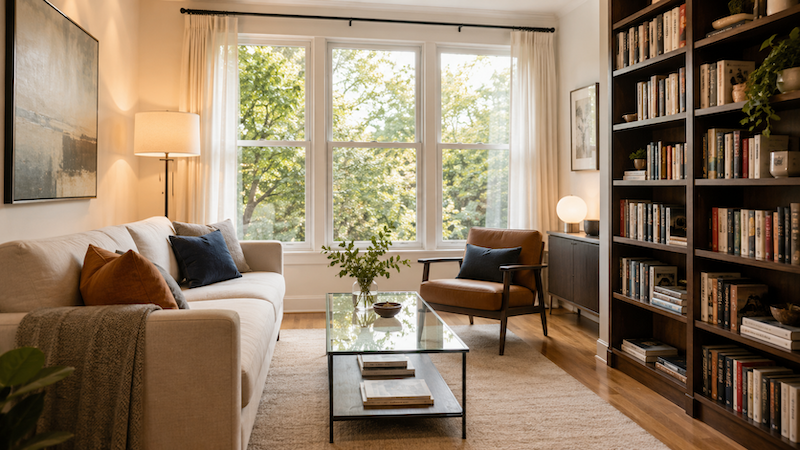
Light is one of the most powerful tools you have in a smaller home. Research has found that more daytime light boosts mood, alertness and sleep quality, which means what you do with your windows matters more than you might think. Swap out heavy drapes for sheer panels or solar shades that let sunlight filter through.
If your layout allows, use glass-topped side tables or furniture with open frames so light can travel across the room without being blocked. Layering lighting, like overhead fixtures, floor lamps and task lighting, also helps fill a space so no corner feels dark or closed off.
2. Think vertically
In a smaller footprint, the floor is premium real estate. The solution is to go up. Wall-mounted shelves and floor-to-ceiling storage draw the eye upward, making a room feel taller and more expansive.
Tall bookcases, stacked kitchen cabinets that reach the ceiling and over-door organizers all put vertical space to work without eating into your square footage. As a bonus, getting items up off the floor makes your home easier to navigate and clean as well as safer for long-term accessibility.
3. Choose furniture that works harder
In a smaller home, every piece of furniture should earn its place. Look for pieces that do double duty, like a storage ottoman that holds extra blankets, a sofa table that serves as a desk or a dining table that folds down when not in use.
Research has found that thoughtful room furnishings support both comfort and day-to-day function. Choosing furniture with individual legs rather than pieces that sit entirely on the floor also helps visually. Seeing more of the floor beneath furniture makes any room feel more open.
4. Use color and contrast
Paint color does more than you might expect. Bright wall paint makes surfaces appear larger, giving any room an instant sense of depth. Painting your ceiling the lightest shade possible also maximizes the sense of height in a room.
Stick to a consistent, light color palette throughout your home rather than painting each room a different shade. Continuity between spaces tricks the eye into reading the entire floor plan as a single, flowing area.
Mirrors work on the same principle. A mirror placed across from a window or another light source, like a lamp, reflects light and visually expands the sense of space.
5. Edit your belongings
No design trick outperforms a well-edited home. Clutter and sensory overload at home elevate stress in measurable ways. In a smaller space, that effect is amplified. Go room by room and ask yourself what you use, what you love and what’s just taking up space.
Donate, store off-site or pass things along to family. What’s left should have a dedicated home, so surfaces stay clear. A tidy, thoughtfully arranged room looks bigger but also feels calmer and more comfortable to live in every day.
The art of spacious living
Your forever home doesn’t need to be large to feel generous. With the right light, color, and a little strategic thinking about what goes where, a smaller space can feel so much bigger. By using these downsizing ideas, you can have a home that is not just bigger in feel, but richer in comfort and function.