A new kind of facility, intergenerational care centers, joins adult day services and child day care, bringing the generations together strategically to benefit seniors and children.
Imagine having a cartful of lively, babbling babies and toddlers roll through your nursing home a couple mornings a week. Or think about the fun you’d have playing balloon volleyball or painting with squirt guns with a bunch of preschoolers in your assisted living’s lawn. Maybe you’d enjoy simply holding and feeding babies every once in a while.
These are scenarios you could expect if you lived in an intergenerational care center, where an eldercare facility shares real estate with childcare. Not only does this innovative model inject energy into senior living settings, but it also has been shown to have powerful benefits for children and older adults alike.
Win/win/win
In a 2018 Harris Poll, 85% of respondents said that if they or a loved one required care, they’d prefer an intergenerational facility over an age-segregated one. That’s because nearly all Americans believe seniors and children have a positive impact on one another.
The most obvious advantage is that bringing these cheerful, curious little ones into senior living communities keeps the residents from becoming socially isolated, which can be damaging not only emotionally but also physically and cognitively.
“Let me tell you, when you have kids in a building, and the kids are running around and providing that variety and that spontaneity, our residents are not bored,” Tami Scheil, administrator of Fairview Manor, a nursing home where an early learning program is also located, told educational newsite EdSurge. “Kids are not predictable. They just provide that spark of life.”
Beyond the fun factor, interacting with kids guarantees that seniors keep moving, and physical activity – whether it’s chasing a ball or just fingerpainting – is so important as people age. Seniors also note that engaging with their young neighbors gives them a sense of purpose and makes them feel more accomplished.
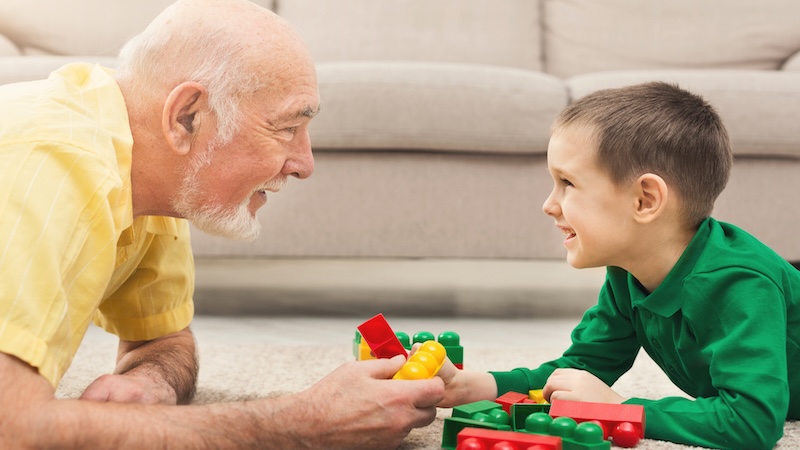
While the kids are playing with their new “grandfriends,” they’re learning new skills, like how to use cookie cutters or make paper airplanes, but also life skills like tolerance and empathy. This arrangement also teaches the children to be comfortable and respectful around older people and helps dispel ageist stereotypes from an early age. With the time and attention they receive from their surrogate grandparents, the children tend to flourish.
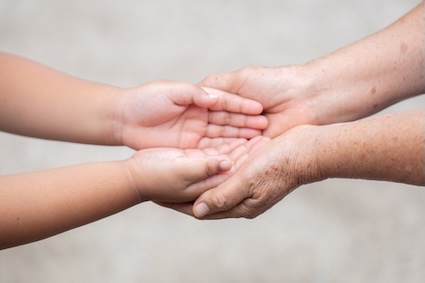 “I get calls from teachers after our kids graduate and go on to grade school,” Keith Leiderman, CEO of the shared adult day care Kingsley House in New Orleans, explained to Stanford Social Innovation Review, “and they say our kids are the most compassionate, empathetic, and accepting children, who don’t think twice about being friends with kids with disabilities.”
There’s yet another winner in this intergenerational equation: the eldercare and childcare facilities themselves. Both of these services realize cost efficiencies by sharing space and sometimes even staff. For example, many use the same food service and maintenance staff.
Some intergenerational programs even give the eldercare staff priority for childcare. This allows employees to keep their children close by and can also be vital when staff has to work hours that traditional childcare can’t accommodate. Plus, childcare is a great hiring incentive for nursing homes and assisted living facilities.
How intergenerational care centers operate
This co-located care model can take many forms. With some intergenerational care centers, the eldercare and childcare are located within the same four walls. Seniors can greet the children as they arrive for school each morning, engage in planned activities with them several times a week, or simply watch the children as they run, skip, and hop through the halls.
“Just walking down the hall and seeing kids’ faces light up – or residents’ faces light up – it makes your whole day,” Kaci Brandt, director of Tiny Images, which is located inside Fairview Manor, explained to EdSurge.
The goal of Bezos Academy, a network of tuition-free, Montessori-inspired preschools funded by Jeff Bezos, is to find mission-driven organizations with space that can be rented for a low cost or free. At Wesley Homes in Des Moines, Washington, Bezos Academy is housed on the same campus as the senior living community, but in a separate building. Children that attend Bezos Academy regularly make the short trip across campus to read with the residents, engage in activities like making homemade playdough, and put on plays and puppet shows together.
A few hurdles
Intergenerational care centers exist throughout the world, but unfortunately, as of 2021, there were fewer than 150 of them in the U.S, according to the Stanford Social Innovation Review. That’s because there are some significant challenges in developing and running these centers.
The first is the rigorous regulations. Operating a facility where the staff must adhere to two different sets of complex regulations can be daunting. Funders also typically focus on either childcare or eldercare; therefore, operators of shared facilities must find and manage separate sources of funding.
Perhaps the most important barrier to placing children in an environment with seniors is the health risk. Young children are known for transmitting germs and seniors are particularly vulnerable. Facilities try to manage the spread of illness through hand hygiene stations, regular cleaning of high-touch areas and equipment, encouraging up-to-date vaccines, and staying vigilant to signs of illness.
But the rewards are worth it
However, the benefits outweigh the challenges, and there has been growing interest in developing more of these co-located centers. “Bringing the generations together actually does place older people in a position where they can see the hope, enthusiasm, and wonder of children,” explains Lyn Phillipson, associate professor at University of Wollongong in Australia, whose research focuses on the benefits of intergenerational relationships, “and the children can also benefit from the wisdom older people can offer.”
Perhaps one day, these facilities will be commonplace, and children and seniors will have greater opportunity to interact with one another on a regular basis – and in so doing, enrich each other’s lives.