The move to a memory care facility can be difficult for the new resident and their family members. Seniors Guide writer Terri L. Jones looks at how staff and loved ones can ease the transition to memory care.
When your loved one was diagnosed with Alzheimer’s disease or other type of dementia, you may have vowed to care for them at home for as long as possible, devoting a great deal of time and energy to that commitment. But lately, their symptoms have progressed significantly, and they’ve needed an increasing (and exhausting) amount of help from you, putting their safety at risk as well as your own well-being.
If you’re seeing physical and cognitive signs that it’s time that your family member moves to a memory care facility, the change can be daunting for both of you. Here’s how to make the transition to memory care a little easier:
Making them feel safe
“At the heart of all dementias is one core symptom, which is that when things change or go unexpectedly, people find it very difficult,” says Dr. Thomas Cope, MRC Cognition and Brain Science Unit and Department of Clinical Neurosciences at the University of Cambridge in the U.K. That includes changes in environment.
Often new residents will experience fear and depression because of the changes as well as increased agitation and confusion. Their appetite may decrease and their sleep patterns shift. You may even witness differences in your loved one’s personality.
During these early days, memory care staff are essential in helping ease the transition to memory care, so choosing a quality facility is essential. The staff’s goal is to get to know your family member – their likes and dislikes, rhythms and needs. They also pay attention to when they become agitated and confused, so that they can make the resident feel as comfortable and secure as possible.
Personalize their space to ease the transition to memory care
For families, one of the most heartbreaking responses to a move is that their loved one wants to go home. But often their references to “home” aren’t simply about a specific place but instead about feeling happy, comfortable, and safe.
According to the Alzheimer’s Association, instead of trying to explain to your loved one that this is their new home, ask them what they miss about home and try to provide whatever they’re longing for. It’s also important to reassure them of their safety and that they are cared for in this new setting.
One way to make your loved one feel more at home is to decorate their room with items that are familiar to them, such as framed photos, a well-loved quilt or blanket, or the lamp that sat beside their favorite chair. You might also bring things that say a little bit about them like a needlepoint pillow that they stitched, a framed poem or scripture that’s important to them, or a trophy from a fishing or sports tournament. Not only will these items make your loved one’s new space feel more personal, but they also will help memory care staff get to know them and even provide valuable conversation-starters.
While decorating their room with possessions they know and love is important, avoid bringing anything valuable that could be lost or even stolen. Also, label everything for security.
Change your perspective
With time, those living with memory loss come to view the memory care facility as their home. For that reason, you might find other residents wandering uninvited into your loved one’s room, using their bathroom, or even opening their closet and trying on a piece of their clothing. While this is perfectly normal for these individuals, it can be disconcerting for family members and require adjusting your way of thinking.
Sonja Dotson, executive director at Commonwealth Senior Living Cedar Bluff, explains that living in a memory care facility is “similar to dormitory living or sharing everything with your brothers and sisters.”
Set a visiting schedule
If you are your loved one’s primary caregiver, you’re accustomed to being with them all the time. That habit may persist even after the move. While visiting on a regular basis ensures the person doesn’t feel abandoned, many memory care communities recommend limiting visits for the first few days – sometimes longer – to give them the opportunity to settle in.
Be sure to ask the staff the best time of day to visit. Commonwealth Senior Living recommends avoiding mealtime, since a visitor may distract the diner and their table mates from eating. In addition, for memory care residents who experience sundowning, becoming agitated or confused as daylight fades, late afternoon and evening visits are discouraged.
Once you start visiting, establish a schedule and consider posting it on a white board or wall calendar in your family member’s room. That way, when your parent is missing you, staff members can remind them when you’ll be back.
Encourage participation
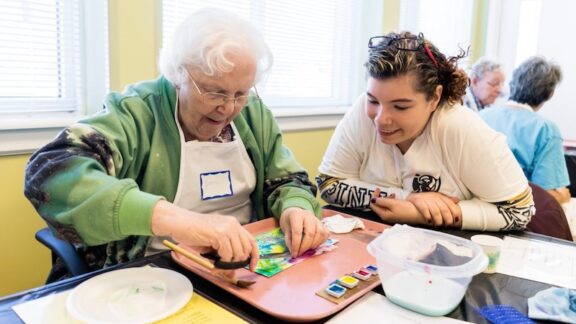
Most memory care facilities offer programs that provide cognitive stimulation, social interaction, and physical activity to their residents. Your loved one may be resistant to participate in these programs at first. When the time is right, gently encourage them to check out activities that may be of interest to them. Perhaps even attend an activity with them if the facility allows.
By playing games, attending exercise classes, and going to music programs with other residents, your family member will more quickly get to know their neighbors and become comfortable in their new surroundings.
Over time, you may even find they’re showing more than just a passing interest in certain other members of the community. If you notice your loved one holding hands or cuddling with another resident, don’t fret – this connection may help them adjust to this new stage of life.
Rebuild a bond
Your loved one isn’t the only one who will go through a transition. After caring for someone for a long period of time, you may feel anxiety about their care and uncertainty or even guilt about your decision. You may also feel that your life has lost its purpose.
Give yourself time. Eventually, you will see that you’ve done what’s right for them and for yourself.
One husband, who had been caring for his wife for years, pointed out an unexpected result of moving her to a memory care facility. Once he was able to offload the heavy lifting of his wife’s care, all the time he spent with her now was quality time. As a result, they’ve been able to rebuild a bond with each other. That’s perhaps the greatest benefit of all.