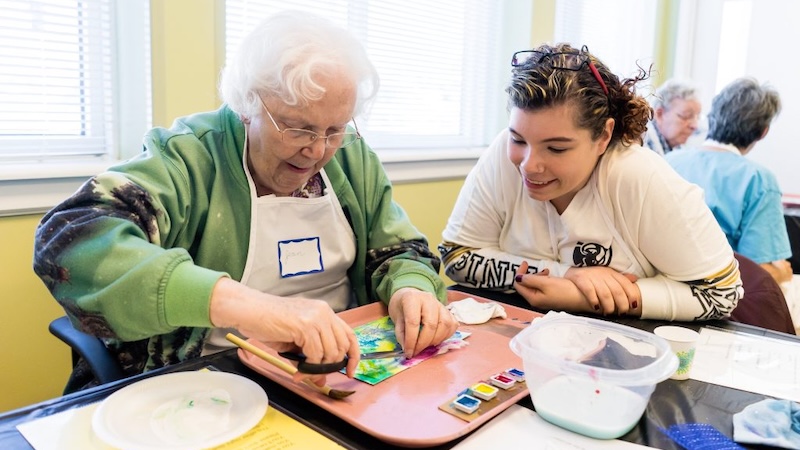
A creative and enriching program, Opening Minds Through Art, demonstrates the benefits of art for people with dementia. The participants and their volunteer partners come away with far more than artwork. Seniors Guide writer Terri Jones explains.
Each week, people living with dementia take part in the Opening Minds Through Art (OMA) program. The participants create art with the guidance of volunteer partners. At the same time, the artists – and their partners – are strengthening communication, changing perspectives, and building relationships.
The program was developed in 2007 at Scripps Gerontology Center, an Ohio Center of Excellence at Miami University. Now presented around the world, OMA is a free, six- to eight-week art-making program for people living with dementia. The program participants are paired with volunteers, including students, family members, caregivers, empty-nesters and retirees, and are encouraged to use their abilities and their imagination – instead of memory – to express themselves creatively through artwork.
Reaping the benefits of art for people with dementia
The program has demonstrated its ability to restore autonomy, dignity, and purpose for the artists. It has also been found to change volunteers’ attitudes and comfort level with dementia, teaching them how to communicate better with anyone living with this disease.
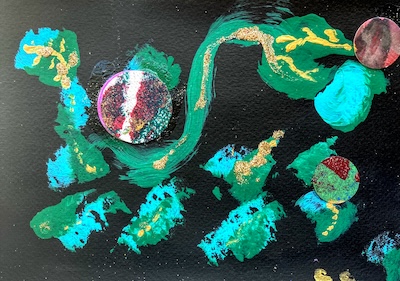
“I found it very difficult to reconnect with my grandfather (who had been diagnosed with Alzheimer’s disease) on a personal level,” explains one OMA student volunteer. “While I have all those shared memories of us together, he did not have the capability to recall all of those. … After being a volunteer with OMA, I now have the strength and the courage to use the knowledge that I’ve learned to rebuild our relationship, not on memories but on these small moments of love and happiness and warmth.”
Benefits of intergenerational engagement
Intergenerational programs like OMA have also been shown to stimulate seniors cognitively and reduce social isolation. These activities can be a bright spot in a senior’s day. One participant’s caregiver reported that the program brought joy, pride and creativity into her loved one’s world and gave him the motivation to recover after a difficult surgery because he wanted to get back to his “happy place, OMA.”
And it goes both ways. Many OMA volunteers say that their older partners have taught and inspired them – sometimes even to change their career paths or majors in college. One student volunteer, who was severely depressed before OMA, says that meeting with her new friend each week gave her a reason to get up in the morning. Other volunteers admit that the experience has changed the way they view seniors. Many have developed close friendships (sometimes even forming a grandparent-grandchild type relationship), which have lasted beyond the program.
“Connecting with my partner each week helped calm all the existential worries and anxieties of young adulthood,” notes one volunteer. “His wisdom, kindness and authenticity have been enriched with age, and tapping into his perspective each week was incredibly grounding. The authenticity, kindness, curiosity, and bravery of each OMA artist give me hope for my future and inspires the type of older person I hope to be.”
Getting seniors involved
Just as with any unfamiliar activity, some participants are initially resistant to participate in OMA, says Stephanie Shanks, director of Intergenerational Programs for Art for the Journey, which trains and supports facilitators and volunteers in and around Richmond, Virginia. “They do not see themselves as artists or they are often not confident exercising agency to learn something new or to be in a new social setting.”
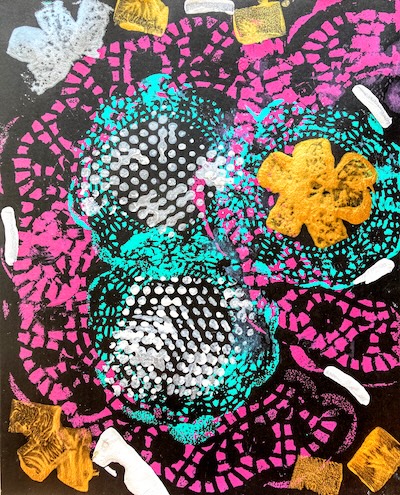
However, after the first session, seniors typically become more enthusiastic thanks to the one-on-one support from the volunteers, who often aren’t even artists themselves. Ranging from 15 years old to retirement age, volunteers are trained in facilitation and person-centered dementia communication skills before engaging with the budding artists. But most importantly, they’re encouraged to be kind, attentive, and affirming throughout the project and to never overwhelm the seniors with too many choices. Conversely, the senior artists aren’t limited in what they create.
“You can do what you want the way you want to do [it],” notes one Richmond-area participant. “You’re just free, free, free.”
After participating in OMA, many seniors, who were previously reluctant to venture beyond their comfort zone, have the confidence to explore other new activities.
Creating artists
Capping off the program is an art show and reception, where the newly minted artists’ works are framed, titled, and displayed. There are flowers, certificates, photos, and speeches honoring the artists, and their artwork is often sold. This gives the seniors, who may never have even dabbled in art before, an exciting new identity as an artist and allows them to leave a beautiful legacy.
“OMA is one of the few things in these individuals’ lives where illness is not emphasized, because when we look at art, everyone is equal and illnesses don’t matter,” explains one volunteer. “And that is a beautiful thing.”
Art for the Journey also offers a Veterans Art Program. Participants enjoy a variety of projects independently, instead of with the one-on-one support from volunteers.
Art for the Journey has trained and certified more than 300 people to facilitate OMA across the U.S. and Canada since 2017. If you know someone who might benefit from participating in the OMA program or you’re interested in becoming a volunteer, find an OMA program near you.