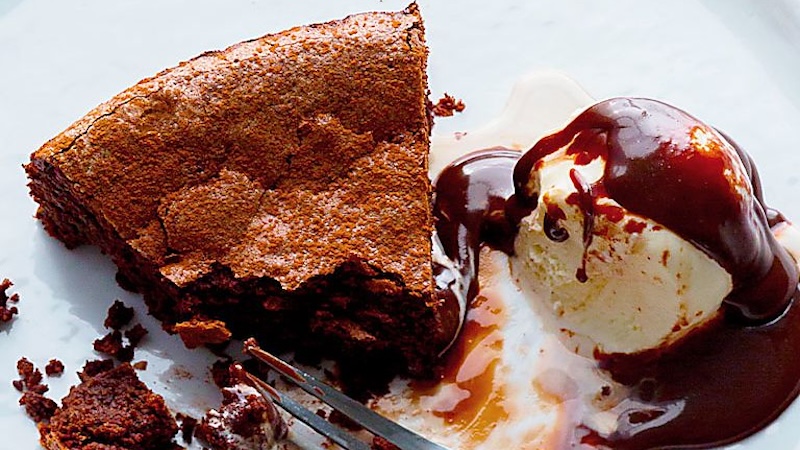
If you’ve got some great chocolate in the pantry and some eggs in the fridge, get your whisk ready, because this flourless chocolate cake recipe does it all. Rich and indulgent, it’s been a classic way to end many a restaurant dinner for generations. This air-lightened, egg-whitened flourless chocolate cake is also a deceptively easy dessert that solves dinner conundrums and suits nearly everyone.
Flourless chocolate cake (aka FCC) needs intense chocolate flavor and a balance of dense and light textures; and of course, you have to actually be able to make the darn thing work. Here are the tricks you need in your toolbox for cake success: top-of-the-line ingredients, a mad amount of egg whites, and a few techniques to get maximum volume and lift.
And although it looks like there are lots of rules about egg white whipping and folding (and there are), take comfort in knowing that the worst thing that can happen if you don’t do the egg whites exactly right in this recipe is that the cake will be a little less light. Dense chocolate? Rename it fudge cake and serve it with pride. In fact, I can’t think of a better recipe to learn on.
Why you’ll love this flourless chocolate cake
- It’s big on chocolate flavor. Sans flour, the chocolate flavor is expansive and has room to sing. The intense flavor of chocolate unencumbered by flour makes this cake paradoxically lighter and richer than most chocolate cakes.
- It’s truly flourless (and gluten-free). More impressive is this cake’s versatility. It is the answer for entertaining folks with different food lifestyles and needs. Believe it or not, not all “flourless” chocolate cakes are truly flour-free; some include a tablespoon or two of flour. Not this one. Need a dessert for Passover? Something gluten-free? Something without white flour? Here’s the recipe for you.
Key ingredients in flourless chocolate cake
- Cocoa powder: Cocoa powder is a rather mysterious baking ingredient for something used so often. Yes, it’s a dry ingredient, but it’s not quite flour, not quite starch, and not quite chocolate. It is what it is: dried roasted cocoa bean powder. Even in this recipe it is not a flour substitute. It does absorb some moisture, but it’s mostly here for the flavor. It adds an underlying bitterness that defines the ferociously addictive taste of chocolate and highlights the sweetness of sugar.
- Chocolate: Finely chopped bittersweet or semisweet chocolate (50% to 64% cacao) gives the cake a deep, rich chocolate flavor. It melts smoothly and creates a fudgy texture that’s essential for flourless chocolate cake. It also balances the sweetness so the chocolate flavor really stands out.
- Eggs: Whipping egg whites gives baked goods lightness. You can quickly and easily whip eggs in a stand mixer. And yes, you can also do it with a handheld electric mixer or by hand using a wire whisk with some zumpf. As you whip the egg whites, they will go through several stages; this recipe calls for whipping until you form “stiff peaks” to take advantage of every inch of height and lift those egg whites can offer. It keeps the cake airy.
Tips on choosing the best cocoa powder
- Spring for the good stuff: There are a few recipes that absolutely require the very best ingredients. This is one of them. It’s pretty simple. There really aren’t too many other ingredients, so it’s all about the chocolate. Go best or go home.
- Dutch vs. natural: Cocoa powder is primarily available in two options: natural cocoa powder or Dutch process (alkalized). Alkalized means that it has been processed to neutralize the natural acidity of the cocoa. There are variations by brand as well, but that is usually a matter of taste and the fineness of the powder. Make sure to read which kind the recipe calls for. Substituting one for the other will change what happens. Maybe not a lot, but enough to drive you crazy if the recipe doesn’t work exactly as you expected.
- Bitter-edged or mild-mannered? The cocoa powder personality test: In this recipe, if you want to drive home the bitterness, use natural cocoa powder; if you want a mellow flavor, use Dutch process. Given that this recipe uses no chemical leavener like baking powder or baking soda, both cocoas work, but choose wisely.
Tips for whipping egg whites
- The sugar and egg white pro-tip: For recipes that call for adding sugar to whipped egg whites, the pastry chef trick is to add it very gradually, starting just before the soft peaks form. If you do it after they hit the soft peak stage, you simply won’t get as much height and fluffiness. If you really wait and blow past soft peaks, the mixture will be gritty.
- The importance of folding: There are a few recipes that absolutely require knowing how to fold. This recipe is one of them. Folding is a method of adding whipped egg whites to your batter that allows the air you’ve just whipped into them to fully benefit the cake. My rules? Use a big bowl and a wide-faced flexible spatula, be gentle, and let a few highlights of egg white shine through.
Helpful tips
- Egg separating tip: Eggs separate better when they are cold, rather than at room temperature, so separate them right after removing them from the fridge. This is key in any recipe that involves whipping egg whites (like this one) because if you get any yolk mixed in with your whites, they won’t whip as well as they might.
- How to get the perfect slice: A chilled cake is easier to cut but room temperature lets the aromas and texture loose. If it’s a picture-perfect slice you’re after, slice the cake while it’s lightly chilled. Regardless of temperature, cut the cake with a thin long knife that is dipped into warm water before each slice and wiped down before slicing again.
Flourless Chocolate Cake
Serves 10
Ingredients:
- 11 tablespoons unsalted butter, at room temperature, divided.
- 2/3 cup plus 1 tablespoon unsweetened cocoa powder, divided
- 10 1/2 ounces bittersweet or semisweet chocolate (50 to 64% cacao), finely chopped
- 6 large egg yolks
- 1/2 teaspoon espresso powder
- 1/4 teaspoon kosher salt
- 1 teaspoon vanilla extract
- 5 large egg whites
- 1/2 teaspoon cream of tartar
- 1 cup granulated sugar
- Melted chocolate, for serving
- Ice cream, for serving
Directions:
- Arrange a rack in the middle of the oven and heat to 350 F.
- Brush 1 tablespoon of the unsalted butter on the bottom and sides of a 9-inch springform pan. Sprinkle with 1 tablespoon of the cocoa powder. Holding the pan over the sink, move it in a circular motion to distribute the cocoa evenly over the buttered surfaces, discarding any excess into the sink; set aside.
- Place the remaining 10 tablespoons butter and 10 1/2 ounces bittersweet or semisweet chopped chocolate in a large microwave-safe bowl. Microwave on the high setting in 15-second bursts, stirring between each burst, until the butter and chocolate are completely melted, 45 to 60 seconds total. Set aside to cool until the chocolate is warm, but not hot, 2 to 3 minutes.
- Whisk six large egg yolks into the cooled chocolate mixture. Sift in the remaining 2/3 cup cocoa powder, 1/2 teaspoon espresso powder, and 1/4 teaspoon salt. Add 1 teaspoon vanilla extract and whisk until completely combined.
- Place five large egg whites in the bowl of a stand mixer fitted with the whisk attachment. (Alternatively, use an electric hand mixer and large bowl.) Beat on low to medium speed until the egg whites are broken up and foamy, 15 to 20 seconds.
- Add 1/2 teaspoon cream of tartar and beat on medium to medium-high speed until the whites form fluffy, droopy peaks when the beater is lifted, 45 to 90 seconds.
- With the mixer on medium speed, gradually add 1 cup granulated sugar and beat until you’ve created glossy, stiff peaks that stand by themselves when you lift the beaters slightly, 1 to 2 minutes. The exact timing will depend on the size and shape of the bowl, the power of your mixer, and other factors.
- Whisk about a 1/4 of the whipped egg whites into the chocolate mixture. Then, with a silicone spatula, gently scoop the remaining egg whites into the batter. With the same spatula, scoop them from underneath, along with some of the batter, and very gently turn the whole thing over; repeat until just incorporated on no streaks of egg whites remain.
- Pour the batter into the prepared pan and smooth the top with a silicone spatula. Bake until the cake has risen ever-so-slightly in the center and is set enough in the center that it will not jiggle when the pan moves; a cake tester will not come out clean, 34 to 37 minutes. The top will have formed an extremely thin, but discernible, crust. The cake will pull away from the side of the pan while it cools; don’t let it bake until it pulls away from the side of the pan while in the oven or it will be overdone.
- Cool completely on a wire rack for at least 1 1/2 hours. Remove the side of the pan and serve with melted chocolate and ice cream if desired.
Tami Weiser is a contributing writer and Jan Valdez an associate recipe producer for TheKitchn.com, a nationally known blog for people who love food and home cooking. Submit any comments or questions to editorial@thekitchn.com.
©2026 Apartment Therapy. Distributed by Tribune Content AGency, LLC.
Make more flourless versions of classic desserts on Seniors Guide:
Flourless Peanut Butter Cookies Recipe