Looking for a new exercise that’s easy to do, gentle on joints, and great for your health? Nordic walking for seniors may be for you.
For many older adults, staying active can become difficult, for a variety of reasons. High-impact activities are off the table, traditional workouts can strain joints, and even daily walking may no longer feel as effortless as it once did. Yet movement is essential for vitality and independence
Enter Nordic walking, which has quietly emerged in senior fitness. Originating in Finland and once used as off-season training for cross-country skiers, this full-body walking technique has become a global favorite for those who want an accessible, joint-friendly, and effective way to stay strong.
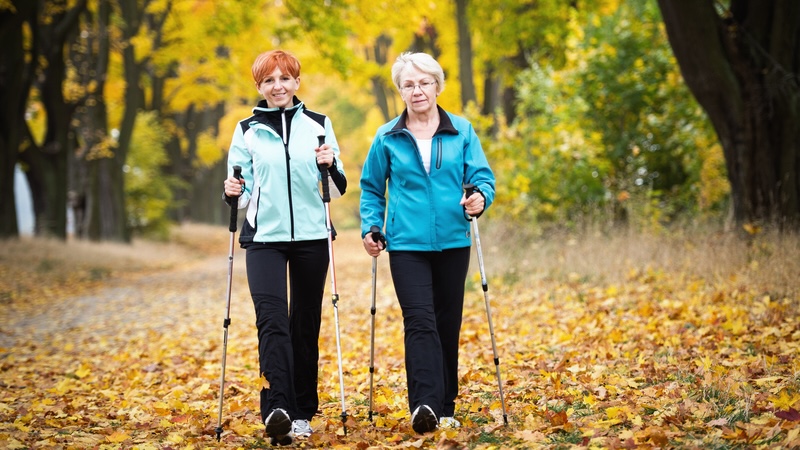
At first glance, Nordic walking looks simple. Just step forward, using a pair of specially designed poles that resemble streamlined hiking poles. But beneath that simplicity lies a unique, precise technique that activates the upper body, improves posture, and distributes the effort of walking more evenly across the body. Instead of relying solely on the legs, as traditional walking does, Nordic walkers engage muscles from shoulders to ankles. According to Harvard Health, Nordic walking activates 80% to 90% of the body’s muscles, far more than regular walking, thanks to the coordinated use of poles and natural arm swing. The result is a form of movement that is low impact, yet surprisingly powerful.
Nordic walking for seniors: total body workout without the strain
One of the biggest appeals of Nordic walking for seniors is that it provides a total-body workout with minimal joint stress. A systematic review and meta-analysis published by the National Institutes of Health (NIH) found that Nordic walking improves aerobic capacity, dynamic balance, upper- and lower-body strength, and overall quality of life in older adults. The poles encourage a natural arm swing that activates the chest, back, shoulders, and core. This muscular engagement supports the spine and reduces pressure on the hips, knees, and ankles.
For older adults managing arthritis, lower back pain, or balance concerns, this redistribution of effort can make movement more comfortable. The poles offer an extra point of support that enhances stability and confidence, allowing seniors to walk farther and with better posture.
Nordic walking also delivers cardiovascular benefits. A 2025 meta-analysis of 22 studies by NIH showed there were reductions in systolic blood pressure, LDL cholesterol, triglycerides, body fat percentage, and waist circumference, along with notable improvements in VO₂ max and aerobic capacity in older adults. Because more muscle groups are engaged, the heart rate rises naturally while the perceived level of exertion remains low.
Improved balance, mobility, and independence
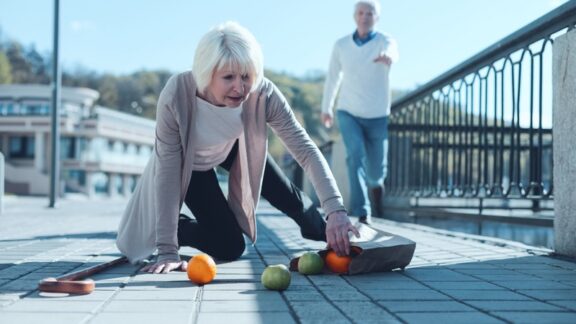
Falls remain one of the most significant health risks for adults over 65. Nordic walking helps address this risk in two essential ways. First, the poles provide steadying support, which increases confidence on uneven surfaces. Second, the technique strengthens the core and postural muscles that play a critical role in stability.
A randomized clinical trial by the NIH found that just eight weeks of Nordic walking led to measurable improvements in balance, walking speed, locomotor ability, and overall quality of life in older adults. As an added benefit: as seniors build their strength and coordination, they also often experience greater ease navigating curbs, stairs, and slopes in their everyday environments.
A boost for mental health and social connection
Exercise is as much about mental wellness as physical fitness, and Nordic walking supports both. The rhythmic, full-body motion of the exercise creates a calming flow that can help reduce anxiety and elevate mood. Many seniors also enjoy and benefit from the outdoor component, with fresh air, nature, and sunlight offering additional emotional positives.
New, emerging research is also linking Nordic walking to brain health as well. A 2025 meta-analysis found that Nordic walking improved executive function, which is important for planning, multitasking, and decision-making, especially in older adults with existing health conditions.
Nordic walking groups and clubs also provide a social element with added benefits, including boosting motivation and accountability, fighting isolation, and making the activity more enjoyable.
Accessibility at most fitness levels
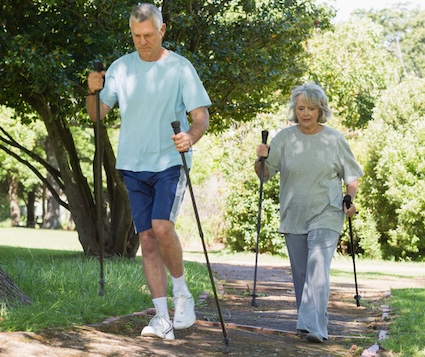 One advantage of Nordic walking is its accessibility. While technique matters, the basics are straightforward and can be learned in an introductory session. Certified instructors help participants use the poles to generate forward momentum rather than simply planting them for balance. Once learned, the movement feels natural and fluid.
Seniors can tailor intensity to their comfort level. Some use Nordic walking for gentle, restorative movement, while others adopt a brisker pace for added cardiovascular training. It adapts easily to beginners, seasoned senior athletes, and even those recovering from injuries.
Getting started with Nordic walking for seniors
For older adults interested in trying Nordic walking, the best starting point is a beginner clinic or local walking group. Many community centers, senior organizations, and parks departments offer guided sessions that help ensure proper technique.
Those starting independently can begin with flat, even terrain such as sidewalks or paved trails. Just 10 to 15 minutes a few times a week can deliver noticeable benefits.
Nordic walking poles differ from hiking poles in two key ways: they feature ergonomic grips with adjustable wrist straps, and their angled tips are designed to help propel the walker forward. Rubber “paws” can be added for pavement or indoor tracks. Carbon fiber or aluminum poles offer stability without adding strain. Adjustable lengths are essential for proper posture and comfort. Beyond the poles, seniors only need comfortable walking shoes with good traction, making this one of the most affordable fitness activities.
When Nordic walking isn’t “better,” just different
Not every study finds Nordic walking superior to all other forms of exercise. Some programs of regular walking or resistance offer similar improvements in metrics like balance or aerobic capacity, but variety is a good thing! Sometimes, the most effective exercise is simply a new activity that feels enjoyable, fresh, and motivating.
Nordic walking stands out for seniors because it blends comfort, accessibility, and measurable impact. Even when it isn’t “better,” it is often different in a good way, being more engaging, supportive, and easier on the joints. Most importantly, it offers seniors a sustainable, enjoyable path to staying active. With a pair of poles and the desire to move, older adults can reclaim strength, confidence, and joy in movement.