Was keeping him at home the right decision? Seniors Guide writer Terri Jones asks this question after seeing the struggles of keeping her father at home. She explores the question many families face struggling between home care or memory care.
My stepmother cared for my dad, who had vascular dementia, for seven years at home before he passed away in May. In the early days after his diagnosis, he didn’t need much support and was even still driving. However, over the last two or three years of his life, my stepmom, Sue, helped him do everything: prepared every meal, snack, and drink for him; helped him bathe and dress; administered his long list of medications by hand; escorted him to the bathroom (with her hand firmly gripping his waistband to keep him from falling); and drove him to doctors’ appointments, his favorite restaurant, and wherever else he needed to go.
The challenges mounted
Toward the end, my father wasn’t sleeping much at night and was becoming extremely agitated, which of course kept Sue up as well. She was exhausted – both physically and mentally – and repeatedly told me and my sister that she couldn’t keep this up much longer. While I dad-sat once a week, and my sister, who lives four hours away, came when she could, we couldn’t fill the void and suggested that Sue hire home care assistants more frequently; but for one reason or another, the arrangement never lasted long-term.
Each time that my stepmother reached her wit’s end, my sister and I would remind her of the option to find a memory care facility for my dad. While she would seem to consider it, ultimately, she would reject it because she had promised to never “put him anywhere.”
When everything changed
Then my father fell. Around 4 a.m. one morning, he got up on his own and took off through the house without his walker. Sue chased after him to stop him, but my dad, who was agitated and delusional, thought she was trying to hurt him and brandished a metal kitty litter scoop to try to fend her off. Fearing for her own safety, she had to let him go. My dad opened the front door and fell down the brick steps, fracturing his hip in the fall.
Before this accident, my father had fallen two other times, landing him in the hospital and rehabilitation. However, this last fall was much worse, requiring surgery and a longer stay in rehab and leading him to experience unrelenting delusions, confusion, and many sleepless nights. Because of his confusion, someone (Sue or I, two extremely kind neighbors, or hired attendants) had to be with him all day and all night for an entire month. It took a toll on all of us, but especially my father!
When my dad was finally discharged, my sister, who is a retired occupational therapist, drove the four hours to my dad and stepmother’s home to help him get settled in. After she stayed up that entire agonizing night with him, the next day, he started experiencing respiratory problems. Sue called the ambulance to take him back to the hospital. There they determined that he had developed double pneumonia from aspirating liquids.
After another several days in the hospital, he came home on hospice on the day before his 87th birthday. Just two days later, we lost him.
Home care or memory care? Was it right decision?
My stepmother, who was married to my dad for 55 years, is happy that she had the love of her life at home with her until the very end (and that is indeed a blessing!). She believed that it was her calling to care for him. But during the hardest periods, I thought my father might be better off in a memory care facility. Now that I have a little distance from the situation, I’m taking the time to reflect on this decision.
Balancing comfort with safety
 My father was undoubtedly more comfortable in his own home than he was anywhere else. Any ER, hospital, or rehab stay was a nightmare for him, causing anxiety, delusions, and sometimes even aggression. Even a visit to my house an hour away was challenging for both him and my stepmom. According to NIH, “For many people affected by dementia, the home represents a site of familiarity, comfort, and safety.”
But living at home was also a risk to my father’s safety. He experienced three significant falls – the first two took many months from which to recover and the last one ultimately led to his death. These accidents were not due to Sue’s lack of care; she was extremely vigilant about my dad’s safety. However, she was just one person, and unfortunately, it was impossible for her to watch his every move.
I wonder if having multiple staff and safeguards in place would’ve kept my father from getting out of bed without his walker and prevented his fall. Kate, whose dad is in memory care, says these facilities “may give you a false sense of comfort that you have professionals providing 24/7 care of your loved one.” Unfortunately, in her own father’s situation, that hasn’t been the case. But of course, all facilities are different.
Related: Is it Time for Memory Care?
Coordinating care
In the years that she cared for my father, Sue had become not only an advocate for my dad but also a coordinator of his health care, doing research about illnesses on her own, finding resources, and often throwing everything against the wall to see what stuck. No one had ever recommended that he see a geriatrician, who understands seniors’ unique needs and manages their health as a whole, until his final months when he was in the hospital for an extreme case of constipation.
My stepmom consulted with this new doctor and, right off the bat, he suggested paring down my dad’s list of medications, which had grown to fill a legal-sized sheet of paper. If my father had lived longer, I’m sure the geriatrician would’ve provided my father with more coordinated care than he was receiving from his array of individual physicians or even his primary care doctor.
A benefit of long-term care facilities, including memory care, is that some have geriatricians on staff. With that specialized, holistic care, my father wouldn’t have had to visit so many doctors or take so many medications in his last years, which probably would’ve given him greater quality of life.
Managing anxiety and delusions
While my father was comfortable at home, that didn’t mean that he always knew he was at home. Frequently, he believed that he was in a house made to look like his real home. In addition to delusions, he also had extreme anxiety and agitation, which got much worse in the last year. Because it was often difficult to pinpoint the origin of his anxiety, we usually didn’t know how to respond to it, and sometimes the inexperienced ways that we handled things made his anxiety worse rather than better.
Memory care staff are trained in strategies to defuse anxiety and agitation in patients with dementia. Beth, an OT with dementia training whose mother is in memory care, advises educating your loved one’s facility about what agitates them and the strategies you have used to calm them. She also says you need to be firm if you don’t want your loved one to be sedated.
We definitely didn’t want my father to be anxious and aggressive, but drugging him – and causing him to become even more confused and potentially incoherent – wasn’t something we could’ve lived with.
Dealing with caregiver burnout
Keeping my father at home was extremely hard on Sue. Toward the end, she had a sitter coming in for several hours a week as well as one to keep an eye on my dad some nights so she could sleep (which, unfortunately, didn’t always work). I also stayed with my dad once a week so my stepmother could occasionally get out. Even so, Sue had little opportunity to see her friends or even go to the grocery store or pharmacy without carting my dad along. Forget shopping for clothes, shoes, or anything that wasn’t absolutely necessary!
Not only that, my stepmom had to put her own health on the back burner, delaying several medical procedures, including a hip replacement. In the months before my father died, Sue, a healthy 80-year-old, was wearing very thin at the seams.
No doubt that a memory care facility could’ve taken a huge burden off Sue’s shoulders; however, my stepmother could never have just dropped him at the door and resumed her life. If my father became anxious and agitated in her absence, which we believed would happen, my stepmother would’ve been there for him as much as she possibly could. That could’ve been as stressful – if not more so – than simply caring for him at home.
Socialization and stimulation
In the last months of his life, my dad saw Sue, me, doctors, and the occasional friend or neighbor who stopped by. He was isolated, but mainly because he wasn’t comfortable with many people as his dementia progressed. As he wasn’t reading much anymore and only watched his favorite television show “Port Protection” and church services on television, he also had very little cognitive stimulation.
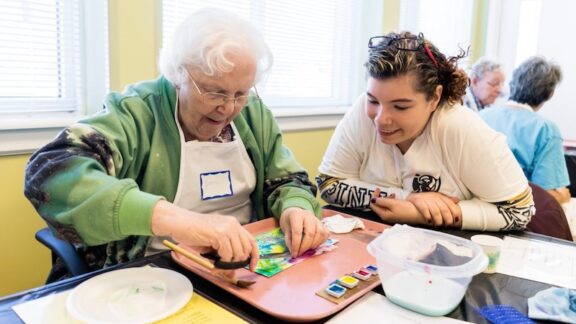
In a memory care facility, he could’ve engaged in activities such as puzzles, art and music therapy, reminiscence therapy and physical exercise. However, my father was an introvert, and in his healthier days, preferred solo pastimes, including hunting, fishing, and gardening. I doubt he would’ve participated in these group activities. In fact, in rehab, he often scoffed at the games the occupational therapists organized or flat out refused to play them!
With time comes clarity
I thought time would give me clarity on the situation and allow me to rationally determine whether keeping my dad at home was the right decision. But even the clear benefits of memory care become a bit murky after factoring in my father’s personality, behaviors, and past experiences.
In the end, I value having had the many hours of one-on-one time with my dad, even as hard as these last years have been (in memory care, I could’ve had a convenient excuse not to make that hour-long drive every week). But most importantly, I know that my father was happier at home than he would’ve ever been in a memory care facility. And when it comes right down to it, that’s what matters to me the most.
Author’s note: This article is not meant to be a recommendation. Every family situation is different. Every family must come to their own decision based on the particular needs of their loved one as well as their own capacity and needs.