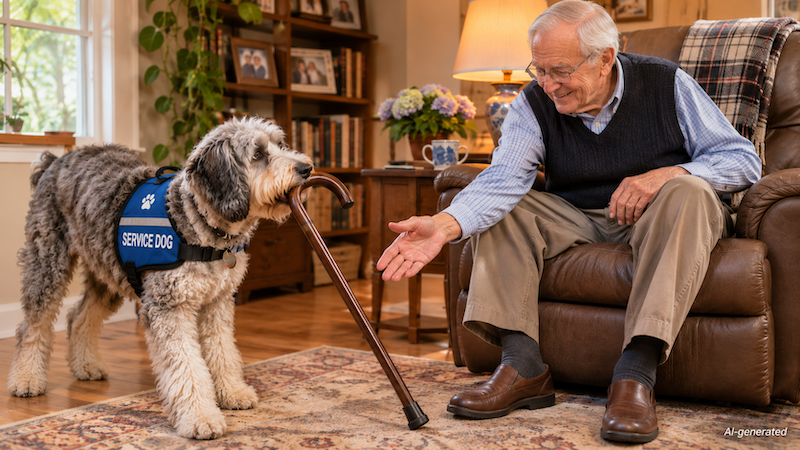
Four paws, a keen mind, and a remarkable set of skills: Service dogs can help seniors live independently longer by helping them navigate daily challenges when they age in place.
To commemorate National Service Dog Month in September, we met with Lori Breece, manager of the United Disabilities Services Foundation (UDS) Service Dog Program, to learn more about the program and how service dogs can assist the aging.
Based in Lancaster, Pennsylvania, Breece has led the program for 14 years and says one of the biggest ways service dogs can help seniors is by picking up items from the floor or ground. That one simple task can reduce the risk of falling, she said, because it prevents a person from “bending over and getting dizzy, losing their balance, getting caught off guard, or falling while picking things up.”
This only scratches the surface of what service dogs can do. In fact, they can be trained to perform more than 100 different tasks, many of which could potentially help seniors ease the burden of daily living at home, so they can be independent longer.
Besides picking up items, service dogs can remove clothes from the dryer, put them in a clothes basket and pull the basket into a room where a senior can sit safely on a couch and fold them.
They can also do things like turn lights on and off, open and close doors, pay for purchases when shopping, or retrieve and deliver items from drawers, cabinets, and refrigerators.
How does a dog know which item to bring? A tag or a small rope can nudge the dog to choose the correct item, whether it’s important medication from a drawer or a canned beverage from the fridge.
Breece explains that this is all part of the dog’s training, tailored to each specific client’s needs. “It’s going to be a partnership between the person and the trainer to help figure out what tasks are going to help that particular person. Then we focus on training the dog for that person,” she said.
UDS trains about 18 puppies annually, with approximately 70 dogs working and 35 in various phases of training this fall. Pups enter 22 months of training when they’re just 8 weeks old, with most placed when they’re 2 years old. The UDS Service Dog Program works mainly with Labrador retrievers and Doodle breeds, like Aussiedoodles, Goldendoodles and Labradoodles.
The need for service dogs is larger than the available dogs, however, and UDS said in a press release that while service dogs can be broadly beneficial, obtaining one remains difficult for many because of financial and accessibility barriers, among other factors.
Related: Could You Become a Puppy Raiser?
Obtaining a service dog requires time & patience
“Our program doesn’t match the next dog ready with the next client on our waitlist. We match the skills of the dogs to the needs of a client, and it can take patience and time to determine the best fit,” Breece said.
The first step to apply for a service dog through UDS is to complete a pre-screen questionnaire online. Then the client coordinator for the program will call to determine if you or your family member is a good fit for a service dog. According to Breece, the coordinator will ask questions like, “What does a typical day look like now? And what do you think would change if you introduced a service dog into that day?”
 If the client coordinator determines that you or your family member is a good candidate for a service dog, there’s an extensive application process that includes a $25 application fee, followed by a virtual or in-person interview.
After this step, UDS encourages applicants to come to Pennsylvania to attend dog trainings and events to get to know the staff, trainers, volunteers, and dogs. Breece says this helps the wait time for a dog, approximately two years, to go by faster.
It’s important to clarify that being a certain age doesn’t automatically qualify someone for a service dog. It all comes down to identifying what a person’s needs are and whether a service dog can improve their lives. For example, if you’re elderly and have mobility issues, that would be a qualifying factor.
“If you have had any kind of knee surgery, hip replacement, balance issues, or a proven fall risk, we can help you. That’s the whole job of UDS,” Breece said. “We want people to be in their homes for as long as they want.” In addition to the Service Dog Program, UDS offers 15 different programs, many of which cater to seniors.
Over the two-year period before a dog is placed, UDS invests $45,000 into each service dog, according to Breece, and, in turn, asks each client to invest $6,000, half at the time of placement and up to a year after receiving their dog to pay the remaining half.
“That $6,000 is going to get them a well-trained dog that’s spayed or neutered, microchipped, and comes with all of their equipment,” she said. Applicants should also weigh the costs of caring for the animal, including food, medications, and regular veterinary checkups.
Besides the time commitment and costs, having a service dog is often a commitment for the animal’s entire life. As the dog ages, the handler can decide to let the dog retire and keep them as a pet, or the animal may simply pass away. If the handler passes away first, their family may choose to keep the dog as a pet, and its certification is removed.
At any time that a person is unable to continue to properly care for their service dog or no longer wants to keep the animal, UDS takes the dog back. Technically, UDS retains ownership rights to the animal throughout its service, while maintaining its certification.
Dogs for companionship
In addition to service dogs to help seniors and others, UDS also provides some emotional support dogs for companionship. These dogs are referred to as therapy or companion dogs instead of service dogs. That’s because the Americans with Disabilities Act (ADA) does not recognize emotional support animals, and therefore, these dogs do not have the same public access rights as service animals.
In other words, Breece explains, “They could work for the person in the home, go everywhere a pet can go, but they couldn’t go into places that had a strict no-dog policy because they wouldn’t be certified.”
Service dogs, on the other hand, have public access rights under the ADA. This means they have the legal right to accompany their handler into all areas of public accommodations, businesses, and state and local government facilities where the general public is allowed to go.
How you can get involved
UDS relies on a dedicated team of volunteers and professionals to train each dog starting when they’re only eight weeks old. Visit the UDS website if you’re interested in learning more about volunteering to raise a pup (you must live within one hour of Lancaster) or would like to donate.
Other service dog programs you may want to check out include Service Dogs of Virginia and the American Service Dog Foundation.