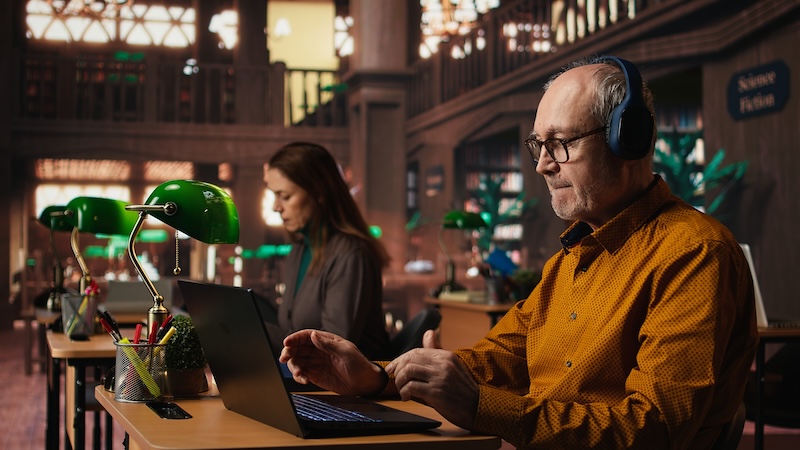
“Anyone who stops learning is old, whether at 20 or 80,” said Henry Ford. “Anyone who keeps learning stays young.” Today’s older adults have access to multiple means of lifelong learning. Diane Harris of Kiplinger Personal Finance explains.
Going back to live on a college campus, taking classes, and mixing and mingling with students young enough to be their grandchildren wasn’t originally on Anna and Jeffry Young’s retirement bingo card. Yet that’s their life these days.
The Youngs’ grand plan when they stopped working several years ago had been to eventually move to a life-plan retirement community [also known as a CCRC, or continuing care retirement community] near their home in Monte Sereno, Calif.; the couple had even put money down to hold spots on waiting lists at two places. Then, while on a 2024 vacation in Arizona, Jeffry, 78, a retired hospital chief of nephrology, and Anna, 74, a former operating-room nurse supervisor, decided to take a tour of Mirabella, an upscale retirement community on the campus of Arizona State University in Tempe. It offered the amenities and continuum of health care options they’d been looking for, along with the benefits of being an ASU student — full access to classes, clubs, facilities and academic, sporting and cultural events, all at their doorstep.
They were immediately hooked. “We just couldn’t walk away from this,” Anna says. “It felt like the retirement we wanted and needed.”
The Youngs moved into a two-bedroom, two-bath apartment at Mirabella last May and have been on an academic tear ever since. Between the two of them, they’ve taken classes on the Constitution, health care economics, and the future of technology. They play in weekly intergenerational bridge games, and they have joined or helped start bird-watching, foreign-policy-discussion and many other special-interest groups. They enjoy concerts by student musicians who live and work at Mirabella, and Jeffry attends an ethics coffee hour with students and other residents.
“It makes you feel like you’re a kid in an academic candy store here,” says Jeffry. Adds Anna, “Moving here in retirement has been quite a gift we’ve given ourselves.”
Whether it’s taking advantage of the many academic courses that welcome seniors on college campuses, enrolling in a program that helps older adults navigate the transition to retirement and redefine purpose in their post-career years, finding senior-targeted classes, or choosing to live in a retirement community affiliated with a university, the opportunities for people 50 and older to pursue lifelong learning are abundant. And the demand, experts say, has never been greater as recent increases in life spans lead to a re-definition for many people of what a satisfying retirement is all about.
“With people living longer than ever, looking at possibly a 90- to 100-year life, longevity is forcing us to see that work-centric learning, focused around employability, is incomplete,” says Simon Chan, founder and CEO of Adapt with Intent, a consulting firm that helps organizations identify opportunities for innovation and growth at the intersection of longevity, work, higher education and retirement. “There’s also great value in learning centered around enrichment, identity, purpose and social connection.”
“Lifelong learning means that you’re curious and open to new experiences, premised on the idea that learning is a personal journey that makes your life more meaningful,” says Chip Conley, cofounder and executive chairman of the Modern Elder Academy, which runs workshops and online courses to help people navigate midlife transitions.
Plus, there are other tangible benefits, Conley notes. “Learning to become a beginner again, whatever the topic, is positively correlated with longevity and improved health — something we should be pursuing our whole lifetime,” he says.
Here is a closer look at the payoffs of lifetime learning and the programs specifically designed for or likely to be of interest to older adults.
Why lifelong learning matters
Learning new things has long been touted as a way to stem cognitive decline — the gradual decrease in memory, judgment and other mental skills that often happens as we age. And research supports that those brain-function benefits are real.
In one study, for instance, older adults ranging in age from 58 to 86 (average age: 72) signed up for three to five classes over 10-12 weeks, the equivalent of a college semester, with instructions to choose courses (options included Spanish, music composition and photography) based on how little they knew about the topic so the learning curve would be challenging. After six weeks, the participants’ cognitive skills, measured by a standardized test, had improved to be on par with people 30 years younger.
And their brain function continued to get sharper until, at the one-year mark, well after the experiment had concluded, the participants’ cognitive abilities were similar to those of college undergraduates — a 50-year improvement, on average, compared with their scores before the classes began.
It’s not yet clear how long the cognitive improvement will last, and most older students won’t take that many challenging classes at once. Still, the results are promising. “It was crazy how much of an improvement in functional abilities there was in every measure we put out there,” says Rachel Wu, an associate professor of psychology at the University of California-Riverside and head of its Cognitive Agility Across the Lifespan lab (CALLA), which conducted this and similar studies.
An even more important benefit of ongoing education when you’re older, says Wu, is simply that it helps you get comfortable with learning again, given how rapidly the world and personal circumstances can change and the importance of being able to adapt. For example, she says, during the pandemic, many people had to learn how to bank online and access telehealth to keep their financial and medical affairs in order. If you’re buying a new car for the first time in 20 years, you’ll need to master how to start the engine without a key and other digital controls. There are constant updates to smart phones, and knowing how to navigate artificial intelligence is rapidly becoming integral to daily life.
“Learning new things is not something you can avoid if you want to stay independent,” says Wu. “If something happens that you have to adapt to and it’s the thirtieth thing you’re learning in the past five years, you’ll be fine; if it’s the first thing you’re learning in 20 years, maybe not so much.”
Perhaps the greatest benefit, says Wu: “We found learning gave our older participants a sense of empowerment, the feeling that they are in control of their own lives.”
Taking classes that enrich your life
 Fortunately, there are plenty of ways to access educational opportunities, with hundreds of programs across the country designed specifically with older adult learners in mind.
Have a hankering, for instance, to take a college class or two, without the stress of homework, exams and grades? Most states make it relatively easy — and inexpensive — to audit courses at community colleges and public universities by offering free tuition or deep discounts to older learners, usually on a space-available basis. Typically, you need to be at least 60 or 65 to participate, and you’re on your own for the cost of books, other course materials, and registration fees. (Find a list of the different rules by state at kiplinger.com/kpf/college-retirees.)
There are also more than 400 college-affiliated Lifelong Learning Institutes nationwide that offer courses and activities primarily designed for people 50 and older. These include 124 membership organizations in the Osher Lifelong Learning Institute Network, known as OLLIs for short, which offer noncredit courses, activities and lectures on topics ranging from history and science to art and current events, with a goal of intellectual stimulation and social connection without grades or tests.
Each OLLI sets its own rules, courses, schedules and pricing. Some may charge a single all-inclusive membership fee that covers classes and activities, while others may charge separately for membership, then on an à-la-carte basis for individual offerings. Total annual costs range from $60 to about $1,000, says Steve Thaxton, executive director of the National Resource Center for Osher Lifelong Learning Institutes at Northwestern University.
History is by far the most popular subject area, says Thaxton — not just traditional courses such as ancient or early American history, but also more offbeat topics such as the history of punk rock, baseball or the local community. “These people have often lived that history — served in that war or worked in that administration — and can share that knowledge with other students, which makes for a very different classroom experience,” says Thaxton.
Members also often make connections beyond the classroom, creating special-interest groups, such as the science book group, the hikers, the travelers or the dinner-out group. “The secret sauce is building community,” Thaxton says. “You get the cognitive benefits that come with academic and intellectual exploration. But it’s as much about developing a friend group where you can talk about what you’re learning and enjoy it.”
Diane Harris is the deputy editor at Kiplinger Personal Finance magazine. For more on this and similar money topics, visit Kiplinger.com.
©2026 The Kiplinger Washington Editors, Inc. Distributed by Tribune Content Agency, LLC.
Read more about lifelong learning on Seniors Guide:
Cheap or Free Online Classes for Seniors